
With JPM and AGBT firmly in the mirror and most (but not all) 2025 year end financial reports having been filed, it’s a good time to take a look at the state of the sequencing market. It is a very strange combination of exciting and boring.
It reminds me of the glaciers I saw this past fall in Alaska. They are incredibly beautiful, immense, and powerful. But are they growing or shrinking? Either way, it’s quite slow and needs to be measured over time to know for sure. (The Harvard Glacier shown above, at about 100m tall and 2km wide, is one of the few that is growing). But if you get up close you see lots of cracks in the face that promise impending excitement. At some point. In the future. Maybe.
The DNA sequencing market is exciting because of the tremendous amount of new competition already on the market and new competition about to come onto the market. Illumina hasn’t sweated this much since having to explain why sequencing using two-base encoding in color space was inferior (or even what the heck “color space” was). Element Biosciences keeps announcing new systems, including a push into the “high throughput” space. Ultima Genomics has driven the price of human WGS to $80. Singular Genomics sort of took a pause, but they’re back with a new spatial sequencer.
But it’s boring because, despite everything “new”, hardly anything has really changed. The market* has been pretty flat over the past five years, dancing around the $5B mark. And during that time, Illumina’s market share dropped only a few percentage points, from ~84% down to ~77%. They lost a little bit to the new short read platforms (which grew from 0% to a bit under 3%), a little bit to the long read platforms (which grew from ~6% to just under 9%), and perhaps ~1% to MGI. Nobody looks like the big winner here.
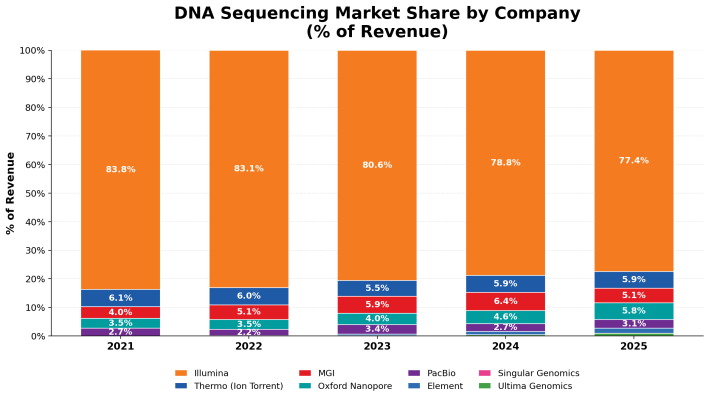
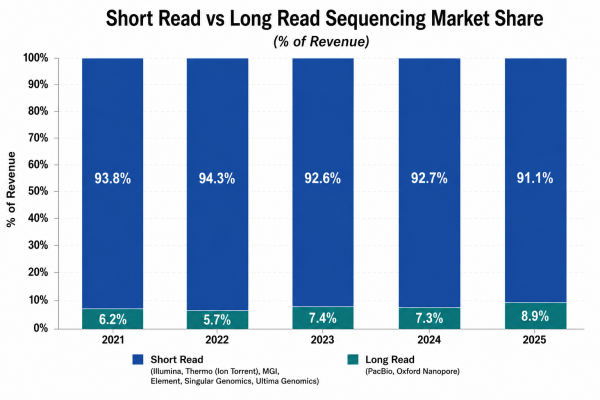
Overall it feels like the market is in a holding pattern. While that’s not ideal for anybody, it’s probably easier for Illumina to bear as they’re profitable and don’t need to keep raising funds to stay alive. Roche will surely try to make things more “interesting” with the launch of their Axelios system “this summer” (tick tock, tick tock…)
Some of the trends on my mind (which I hope to expand upon in future posts) is the evolving field of “high throughput” sequencing (with Element and Roche about to enter the conversation), the focus on the “full sequencing stack” (e.g. Illumina’s push into single cell and spatial genomics), the slow rise of the long read market, and the evolution of the Chinese genomics market.
And, remember, sometimes interesting things happen if you wait long enough…

* I’m defining the market as “revenue from sequencing instruments and the reagents used to operate them” as a proxy for the popularity of the various platforms. It’s impossible to get perfectly clean revenue numbers for a whole host of reasons, but I do my best. See my original post on this topic for a general idea of my methodology (2022 Sequencing Market Share – Same As It Ever Was (For Now)). Note that I’m now including Illumina sequencing services in the total and I’m no longer parsing ONT’s revenue as they stopped reporting LSRT as a separate number (likely because non-sequencing revenue is small enough to be irrelevant now).